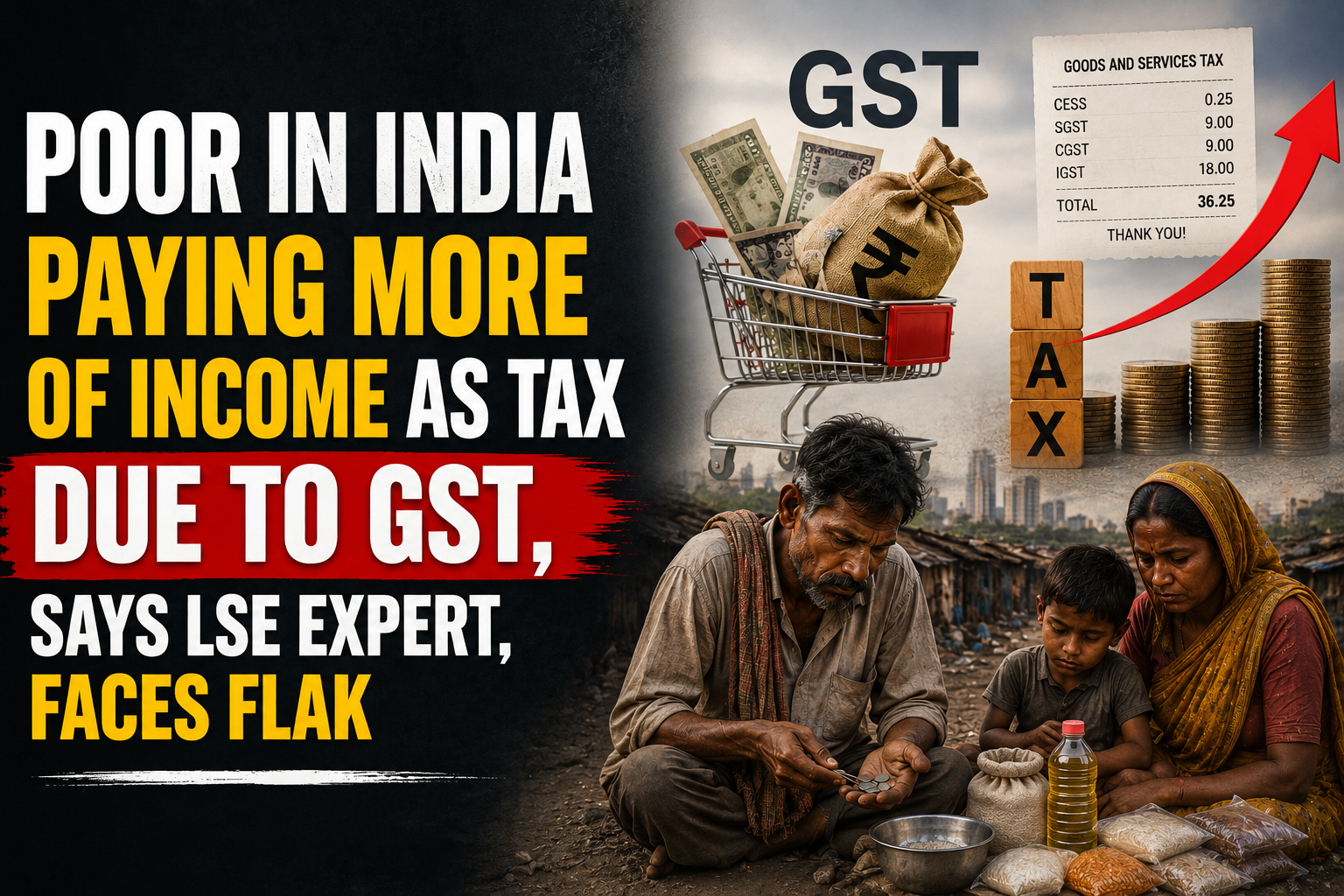




Poor in India paying more of income as tax due to GST, says LSE expert, faces flak
The poor in India are paying a higher proportion of their income in tax due to the Goods and Services Tax (GST), claimed Mukulika Banerjee, an anthropologist at the London School of Economics, in a podcast. Experts, however, fact-checked her, saying that the basket of products used commonly in India, including by the poor, is mostly untaxed or faces 5% GST at best.
In a podcast with Pervaiz Alam, a former BBC journalist, Banerjee claimed that the flat consumption tax regime of the GST burdened the poor more.
The GST is an indirect tax that is paid for consumption. Most unpackaged products of daily use are tax-free while some attract 5% GST. The 2026-27 Budget, brought in GST 2.0 reforms, removing tax on several items or reducing the tax rate. It also made the GST regime a two-rate system of 5% and 18%, alongside a few special and luxury items at 40%.
The new rates kicked in from September 22, 2025. Essentials and daily-use goods such as food grains, medicines, basic dairy items and educational products attract a 5% GST. Unpacked foodgrains, lentils, fruits and vegetables are not taxed under GST. In fact, paneer (cottage cheese), fresh meat, fish and eggs also don't attract any GST.
"In India, when people use the word 'tax', they immediately think of income tax. People like us tend to think that we are the taxpayers because only a very small percentage — around 3% — pay income tax in India. So people assume that 3% of Indians pay taxes while the remaining 97% simply benefit from them," said Mukulika Banerjee in a podcast with Pervaiz Alam.
"But the truth is that GST applies to everyone. Everyone pays indirect taxes, and poorer people in India are actually paying more tax in proportion to their income than the rich," she argued in the Cine Ink podcast with Alam.
The anthropologist from the London School of Economics (LSE) tried to explain it through the example of Parle-G biscuits.
"Look at it this way. If you buy a packet of biscuits and a rickshaw puller buys the same packet, both of you pay the same GST on it. But the rickshaw puller earns far less than you. So, relative to his income, he is paying a much larger share as tax," said Banerjee.
"If you aggregate this across the country, the bottom 50% of India's population is paying proportionately more tax relative to their income," she added.