


Nine years of GST: A look back and way forward
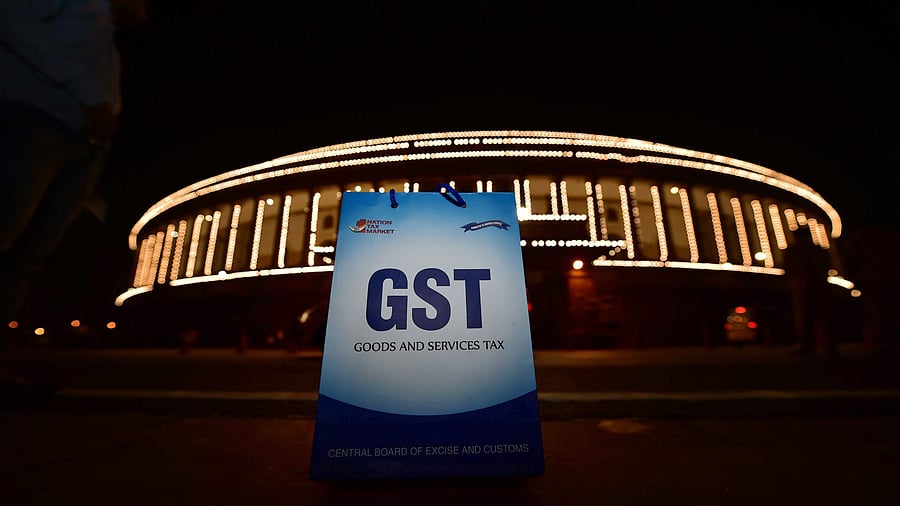
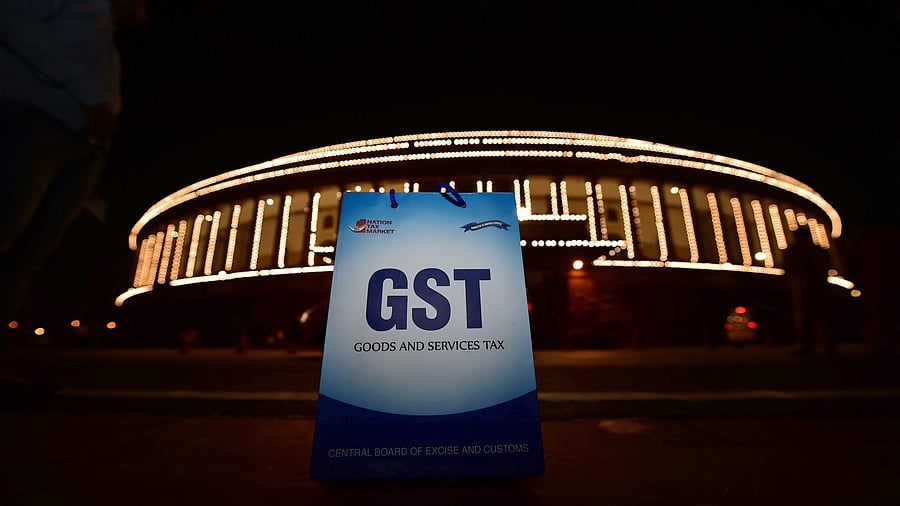
The then Parliament building illuminated ahead of the midnight launch of the 'Goods and Services Tax (GST)' in New Delhi, on June 30, 2017.
At midnight nine years ago, the Indian Parliament’s Central Hall witnessed the nationwide launch of a new Indirect Tax regime, the Goods and Services Tax (GST). The deficiencies of the old tax system, the cascading effect, multiple state and Central levies, and the absence of an integrated tax administration had led to the introduction of the ‘One Nation, One Tax, One Market’ regime.
In another two days, the GST regime will enter its tenth year. Now the question is: Whether the GST succeeded? To what extent? Were all the promises delivered? Are end-consumers benefitting? What are the issues that still haunt the economy? And what is the way forward?
More Formalised Economy
The implementation of GST has brought several advantages to the economy. A fully-integrated national market from Kashmir to Kanyakumari, standard tax rates, prevention of the cascading effect, checkpost-free state borders, reduced incentives for tax evasion, harmonised rules and procedures, among others.
As a result, currently, there are 1.65 crore taxpayers registered under the GST, compared to 67.80 lakh unique registrations under the old VAT and service tax regimes.
Mandatory registration based on an annual turnover, i.e., Rs 40 lakh for goods and Rs 20 lakh for services, to make inter-state supplies, and to claim input tax credit, drawing most of the business into the GST’s ambit. To avail those benefits, the businesses with less than the prescribed turnover limits are also getting registered under the GST voluntarily.
Due to the advent of the internet and technology, a formally-registered business can be found even in rural areas.
Fine Example of Cooperative Federalism
The GST regime is a good example of cooperative federalism. Our successful consumption-based tax is a role model for other developing economies.
Unlike earlier, both the Centre and the states have concurrent power on levying tax on goods and services. It has effectively disposed of the compartmentalisation of taxing powers at different levels: local, state, and Centre.
The GST Council, an apex policy-making body, brings the Union Finance Minister and all the states’ finance or tax heads together. So far, a total of 56 GST Council meetings have been held periodically at different locations.
All its decisions arrived at consensus, except in one instance, taxation on lotteries, obtained through voting in the 38th GST Council meeting held in December 2019.
Record-Breaking Revenue Buoyancy
Since inception, the gross GST collections have been steadily increasing month-after-month, year-after-year, except in pandemic-hit years.
For July 2017, the first month’s taxes collected in August 2017 were about Rs 94,603 crore. Now, the average monthly gross GST collection stands anywhere between Rs 1.80 lakh crore and Rs 1.85 lakh crore.
The highest monthly gross GST collection at Rs 2.43 lakh crore was recorded in April 2026. Financial year-wise, the 2025-26’s total gross GST collection at Rs 22.27 lakh crore recorded as the highest-ever gross GST collections.
2025’s GST Rate Rationalisation
The GST Council, in its last meeting held on September 3, 2025, in New Delhi, has recommended the much-delayed overhaul of GST rates and slabs.
GST rates on daily essentials were reduced considerably. Most of the goods are now being taxed either at 5% or 18% brackets. GST slabs also reduced from the initial five slabs to three slabs — merit 5%, standard 18%, and luxury and de-merit 40%, for a select few items, effective from September 22, 2025, midnight.
An informal observation on consumer behaviour between April 2025 and June 2026 reveals a positive shift. The consumption of daily used food items has witnessed a strong growth during the last nine months, compared to April-August 2025.
Significant reduction in taxes, a contributory factor in making them more affordable, resulted in higher sales growth. For instance, ultra-high temperature milk, paneer — pre-packaged and labelled, pizza bread, and chapati, are listed under ‘0’ or ‘Nil’ tax brackets.
Condensed milk, butter and other fats, cheese, and dry fruits were moved from 12% to 5% tax bracket.
In the automobile industry, the tax rates were reduced from 28% to 18% on two-wheelers (>350cc) and small cars (>1200 cc for petrol/1500 cc for diesel).
The significant reduction in tax rates and the festive season’s special discount have made them more affordable, benefited entry-level commuters and boosted sales.
The tax reduction has reduced prices of two-wheelers — Honda Activa, Hero Splendor, and Bajaj Pulsar — between Rs 5,000 and Rs 24,000.
October 2025 alone recorded a retail sale of 31.50 lakh units, an unprecedented 52% growth YoY. Similarly, passenger vehicles, including small car sales, during October 2025, recorded an all-time high sales of 5.57 lakh units, again an unprecedented 40.50% growth YoY.
Tech-Backed Indirect-Tax Regime
The GST regime is fully-supported by tech-backed administration, from registration to regular compliance. It has minimised the efforts for taxpayers, zero manual intervention and provided an efficient system at their disposal for tax officers.
Interestingly, the commercial banks, having confidence in the system, are extending crucial overdraft facilities and working capital loans from Rs 1 lakh to Rs 5 crore purely based on GST invoices/returns.
Non-Inclusion of Certain Goods
While implementing the GST, the Centre has kept liquor, natural gas, petroleum products, and electricity from GST purview. Due to the absence of states’ consent, their inclusion was not as easy as thought.
The reason could be that the effective sales tax on petroleum products varies from state to state, where, in the case of Maharashtra, it is 40%, and in the Andaman and Nicobar Islands, it is 6%.
Petroleum products and liquor alone are used to generate approximate 40% of the total indirect taxes under the erstwhile VAT regime, hence, the states’ apprehension is that if included, it will impact their fiscal independence further.
There are undelivered promises, a partially-resolved inverted duty structure, seamless input tax credit in a true sense, and an efficient dispute resolution that are still haunting the system.
It is reported that the upcoming GST Council meeting is likely to be held in mid-July 2026 in Kolkata, and to address these issues on priority.
The Way Forward
Given India’s geographic vastness, different business models, political compulsions, and complexities in getting everybody on board are not as easy as said to be.
No doubt, a major challenge that India has successfully embraced.
As we set the tone for an ambitious Viksit Bharat by 2047, all those concerned are expected to pull up their socks and move towards collective growth.
Source : https://www.deccanherald.com/business/economy/nine-years-of-gst-a-look-back-and-way-forward-4055425